
The UK tax system is undergoing one of its biggest digital transformations. HMRC’s Making Tax Digital (MTD) initiative aims to modernise tax reporting by replacing paper records and annual returns with real-time digital submissions.
For small businesses, contractors, and sole traders, this isn’t optional—it’s a legal requirement. Yet almost half (45%) of sole traders say they feel unprepared for MTD. If your business isn’t ready, you could face penalties, disruption, backlogs, or compliance issues.
This guide explains what MTD means, who it affects, key deadlines, and how to prepare your business.
What Is Making Tax Digital?
Making Tax Digital is a government initiative to simplify and digitalise the UK tax process. Instead of submitting one annual return, businesses and landlords will keep digital records and send quarterly updates to HMRC via approved software.
Core Features
- Digital record-keeping: Maintain all income and expense data in a recognised digital (HMRC-approved) format.
- Quarterly updates: Replace your yearly Self-Assessment with quarterly submissions to HMRC.
- MTD-compatible software: Submissions must be made via HMRC-recognised accounting software or bridging tools.
The objective? To reduce errors, increase efficiency, and provide better visibility of your finances throughout the year.
Making Tax Digital Deadlines
MTD is being rolled out in stages, depending on your business type and income level:
| Tax Type / Business | Start Date | Threshold / Notes |
| VAT-registered businesses | Already mandatory (since April 2022) | All VAT-registered businesses must use MTD regardless of turnover. |
| Income Tax Self-Assessment | From April 2026 for higher incomes | Self-employed / landlords with income over £50,000. |
| From April 2027 | Those earning over £30,000 will fall within scope. | |
| Corporation Tax | To be confirmed | HMRC has indicated it plans to bring in MTD for Corporation Tax, but no date is set. |
- Around 7 million people filed via Self-Assessment (self-employed + landlords) in 2023-24.
- 9 million of which have a qualifying income above £20,000 and will therefore need to join MTD for Income Tax.
- From April 2026 businesses with a qualifying income over £50,000 will need to join MTD. That accounts for 864,000 people according to 23/24 figures.
- Over 1 million individuals with a qualifying income between £30,000 and £50,000 will need to join MTD in April 2027.
- A further 975,000 with a qualifying income of between £20,000 and £30,000 will join MTD from April 2028.
How Small Businesses Can Get MTD-Ready
- Check if MTD applies to you – Determine your income level and upcoming start date.
- Register with HMRC – Sign up before your first digital submission deadline.
- Adopt MTD-compatible software – Move away from manual spreadsheets and onto approved systems.
- Train your staff – Ensure everyone who manages finances understands the new process.
- Test early – Submit a trial return before it becomes mandatory to iron out issues.
Choosing the Right MTD-Compatible Software
Using MTD-compatible software is essential. Look for systems that:
- Integrate seamlessly with your existing accounting workflow
- Offer real-time reporting, digital record-keeping and cloud access
- Are officially approved by HMRC
- Provide strong customer support and data security
Popular MTD-ready platforms: Xero, QuickBooks, Sage, FreeAgent, and Zoho Books.
At Graham Wood Accountants, we help clients select, set up, and train staff on the right digital accounting tools.
Risks Of Ignoring Making Tax Digital
Failing to plan for MTD isn’t just inconvenient; it carries financial, operational and reputational risks too.
HMRC has confirmed that late or missed submissions will attract penalties under the new points-based system. Accumulating points can lead to fines and interest charges.
- Increased Admin Pressure
Switching at the last-minute means rushing to implement software and train staff, often when deadlines loom. This can lead to stress, mistakes, and duplicated effort.
- Lost Productivity
Without proper planning, staff could spend more time fighting tax issues than actually running the business. HMRC’s research shows that poorly prepared businesses face higher initial admin costs than those who plan early.
- Reputational Impact
Late or inaccurate submissions can undermine your credibility with lenders, investors, and clients, particularly if you operate in a regulated industry.
Avoid costly mistakes and penalties, get proactive support from the Graham Wood team today!
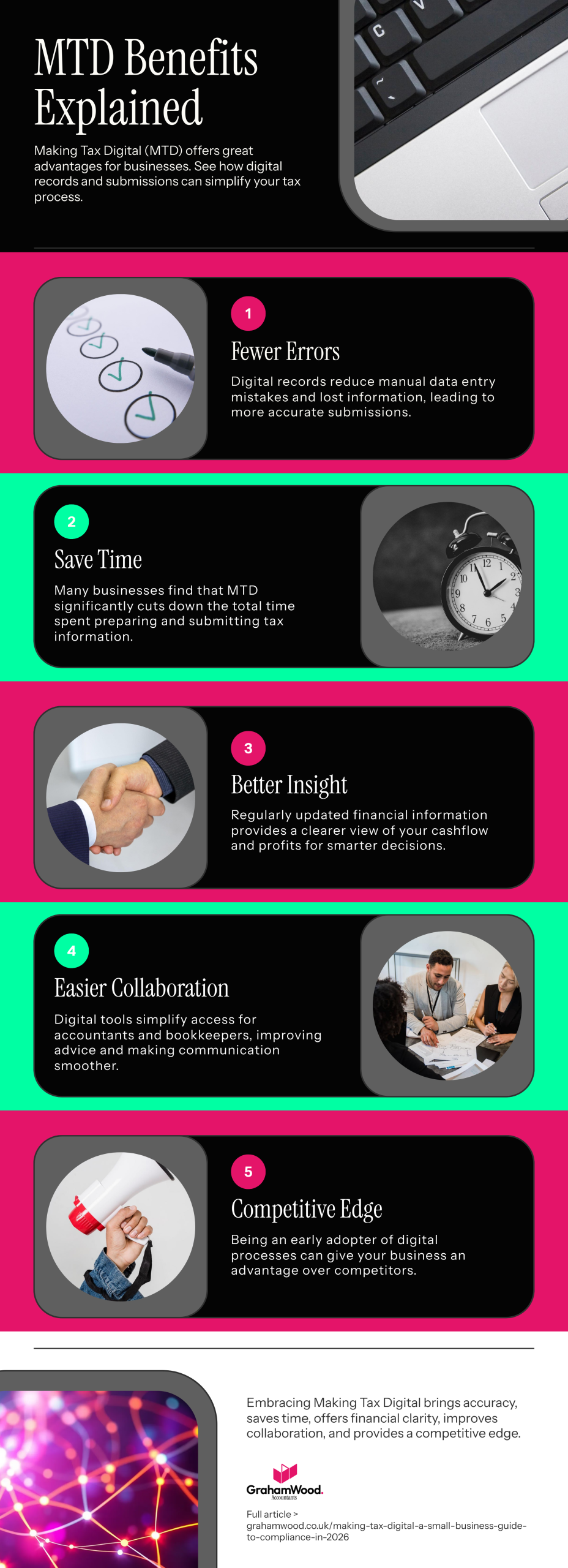
Benefits of Making Tax Digital
While the transition requires effort, early adopters of MTD—particularly for VAT—are already reporting clear gains:
- Fewer Errors, More Accuracy
HMRC estimates that avoidance of manual entry errors is one of the largest long-term savings for small businesses. Digital records reduce mis-keying and missing data.
- Time Savings
According to HMRC’s impact study, 31% of businesses said MTD helped reduce overall time spent on tax submissions.
- Better Financial Insight
Quarterly updates mean you get an up-to-date picture of cashflow and profits, helping with budgeting and decision-making.
- Easier Collaboration
Digital systems make it simpler for accountants and bookkeepers to access records, improving advice and responsiveness.
- Competitive Advantage
Adopting digital tools early can give you a head start on competitors, with more efficient processes and better data-driven planning.
How Graham Wood Accountants Can Help
At Graham Wood, we specialise in helping small businesses transition smoothly to Making Tax Digital.
Our services include:
- VAT & Tax Returns: Accurate submissions for VAT, Self-Assessment, and Corporation Tax.
- Bookkeeping & Accounts: Keep your financial records up-to-date and compliant.
- Payroll & HR: Managed payroll and employee compliance.
- Business Planning & Advice: Strategic guidance on growth and tax efficiency.
Whether you’re already VAT-registered or preparing for MTD for Income Tax, our experts can guide your every step of the way.
Don’t wait until the deadline! Contact us today to get Making Tax Digital ready.
FAQs
Do I need to sign up for MTD if I’m a sole trader?
Yes—if you meet the income thresholds when MTD for Income Tax becomes mandatory.
Can I still use spreadsheets?
You can continue using spreadsheets, but you’ll need HMRC-approved bridging software to link your records to HMRC.
Will MTD increase my admin workload?
Initially, there’s a learning curve. But with the right software, digital records can save time and reduce errors.
Can my accountant handle MTD submissions for me?
Yes. Many accountants can manage your MTD reporting on your behalf, ensuring you remain fully compliant.
Can MTD help me avoid penalties?
Yes. By submitting accurate, timely digital records, you reduce the risk of fines and interest.
Do I need separate software for VAT and Income Tax?
Not always. Some platforms handle both; others require bridging software. Make sure to check with your provider.
What if my business income changes mid-year?
Your software and accountant can help you adjust reporting as your income changes to remain compliant.